
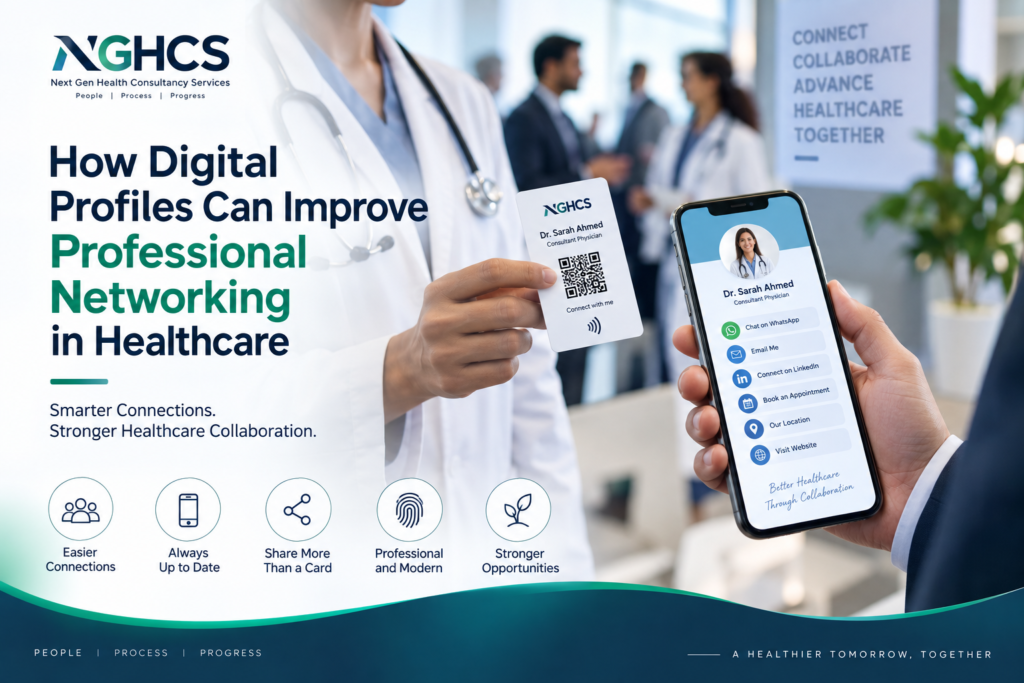
Healthcare has always been built on relationships. doctors connect with other specialists. Clinic owners meet technology providers. Hospital leaders speak with consultants, insurers and suppliers. Healthcare professionals attend conferences, exhibitions, training sessions and industry meetings throughout the year. but the way professionals exchange information is changing. Instead of relying only on printed business cards, many professionals are now using digital profiles in healthcare to make it easier for people to save their contact details, visit their website, connect on LinkedIn or reach them through WhatsApp.
For healthcare professionals in the UAE, where networking is an important part of business development and professional collaboration, this can provide a much more practical way to stay connected.
What Is a Digital Professional Profile?
A digital professional profile is a shareable online page containing the key information someone may need after meeting you.
Depending on the platform, a profile may include:
- Full name
- Professional title
- Organization
- Mobile number
- Email address
- Website
- LinkedIn profile
- Social media profiles
- Clinic or office location
- Appointment or booking links
- Company information
- Professional biography
Instead of giving someone several different links, a professional can share one page.
That page can then be accessed through a web link, QR code or, in some cases, an NFC-enabled business card.
Platforms such as TAPS are built around this type of digital profile and contact-sharing experience.
The concept is simple: make it easier for someone you meet to find the right information about you without searching through several different platforms.
Why Networking Matters in Healthcare
Healthcare professionals often think about networking differently from people working in traditional sales industries.
A doctor’s main responsibility is patient care, not collecting business contacts.
However, professional relationships still matter.
A strong healthcare network can support:
- Specialist referrals
- Professional collaboration
- Continuing education
- Recruitment
- Healthcare partnerships
- Technology implementation
- Insurance relationships
- Business development
- Research opportunities
- Medical events
- Industry knowledge sharing
For clinic owners and healthcare executives, networking can also create relationships with consultants, suppliers, technology providers and other organizations that support healthcare operations.
The challenge is not necessarily meeting people.
The challenge is staying connected after the meeting.
The Problem With Traditional Business Cards
Printed business cards are still useful and are unlikely to disappear completely.
They are simple, familiar and easy to exchange.
However, they also have limitations.
A card may contain only:
- Name
- Job title
- Phone number
- Website
If any of that information changes, the card becomes outdated.
A recipient also has to manually save the details into their phone.
And after a large healthcare conference, a person may return with dozens of cards without remembering exactly who each person was.
That is where a digital profile can add value.
It does not necessarily need to replace the printed card.
It can make the information behind the card more useful.
1. Digital Profiles Make Contact Sharing Faster
One of the most practical benefits of a digital profile is convenience.
Imagine meeting someone at a healthcare conference.
Instead of saying:
“Here is my number. Let me also give you my email. You can find me on LinkedIn as well.”
You can share one QR code or profile link.
The person can immediately access the information you want them to have.
For busy healthcare professionals, that small improvement can make networking much smoother.
This is particularly useful during:
- Medical conferences
- Healthcare exhibitions
- Training events
- Networking dinners
- Business meetings
- Hospital visits
- Industry workshops
2. Your Information Can Stay Up to Date
Printed information can become outdated surprisingly quickly.
A professional may:
- Change position
- Join another clinic
- Change a phone number
- Update a website
- Add a LinkedIn profile
- Move office location
With a printed card, you need to print new cards.
With a digital profile, the information can usually be updated without changing the link or QR code people already have.
For healthcare professionals who move between organizations or take on new responsibilities, this is particularly useful.
3. You Can Share More Than Contact Details
A business card has limited space.
A digital profile does not have the same restriction.
This means a doctor or healthcare professional can provide useful professional information without making the profile feel crowded.
For example, a doctor might include:
- Specialty
- Clinic name
- Clinic location
- Appointment page
- Professional biography
- LinkedIn profile
A healthcare consultant may include:
- Company website
- Services
- Company profile
A healthcare business owner may include direct links to several business channels.
The goal is not to add everything.
The goal is to make the most relevant information easy to access.
4. Digital Profiles Can Create a Better First Impression
Professional image matters in healthcare.
This does not mean a profile needs to be flashy.
In fact, healthcare professionals often benefit from the opposite.
A clean, simple and well-organized profile can make it easier for someone to understand:
- Who you are
- What you do
- Where you work
- How to contact you
If someone has to search for your clinic, guess which LinkedIn profile belongs to you or search through old messages to find your number, there is unnecessary friction.
A professional digital profile reduces that friction.
5. It Can Help Professionals Stay Connected After Events
Healthcare events create a lot of introductions in a short period of time.
During a conference, you may meet:
- Doctors
- Hospital managers
- Healthcare entrepreneurs
- Technology vendors
- Insurance representatives
- Pharmaceutical professionals
- Consultants
- Government or industry representatives
The conversation may be good, but if there is no easy follow-up, the relationship may end there.
A digital profile makes it easier for someone to save your information while the conversation is still fresh.
For organizations involved in healthcare events, digital networking tools can also improve the overall event experience by making professional introductions more useful.
6. Digital Profiles Can Support Professional Visibility
Healthcare professionals increasingly have a digital presence whether they actively manage it or not.
Patients, colleagues and business contacts may search their name online.
A digital professional profile gives the individual more control over where people go next.
For example, you might want a new contact to visit:
- Your clinic website
- Your professional LinkedIn profile
- Your appointment page
- Your company website
- Your WhatsApp contact
Instead of allowing people to search randomly, a profile gives them a direct route.
This can be useful for both individual professionals and healthcare organizations.
7. They Can Be Useful for Doctors Without Becoming Promotional
One concern healthcare professionals may have is whether digital profiles make their personal brand feel too commercial.
They do not have to.
A doctor’s profile can remain extremely professional.
For example:
Dr. Name
Consultant Cardiologist
Hospital / Clinic Name
Then provide only the relevant contact and professional links.
There is no need for sales language or unnecessary marketing.
The profile simply acts as a modern contact card.
That distinction is important in healthcare, where credibility and professionalism matter more than aggressive promotion.
8. Digital Profiles Can Help Clinics Maintain Consistency
Digital profiles are not useful only for individuals.
Healthcare organizations can also use them to create more consistent professional identities across their teams.
For example, a clinic could standardize:
- Doctor profile layouts
- Clinic branding
- Contact information
- Website links
- Location links
- Appointment links
This avoids a situation where every member of the team represents the organization differently.
Consistency can also make the clinic appear more organized and professional.
For a growing healthcare organization, this becomes increasingly important as more professionals join the team.
9. QR Codes Can Make Offline Networking More Useful
QR codes provide a bridge between physical and digital networking.
A professional may place a QR code on:
- Business cards
- Event badges
- Conference stands
- Presentations
- Brochures
- Office signage
- Email signatures
A person can scan the code and immediately open the digital profile.
This can be especially useful at exhibitions and conferences where professionals are moving quickly and may not have time for long introductions.
10. NFC Can Make Contact Sharing Even Simpler
NFC, or Near Field Communication, can allow one device to share information with another when brought close together.
Some digital networking platforms combine NFC cards with an online professional profile.
The experience can be very simple:
The healthcare professional taps the card against a compatible smartphone, and the profile opens.
There is no need to type a web address.
There is no need to search for a name.
For professionals who attend frequent meetings or events, this can make repeated contact sharing more convenient.
11. Digital Profiles Can Support Healthcare Entrepreneurs
Healthcare entrepreneurs often need to represent both themselves and their organization.
For example, a clinic founder may need to share:
- Personal professional details
- Clinic website
- Company profile
- Contact details
- Business location
A digital profile allows this information to be connected in one place.
This can be particularly useful for healthcare startups during the early stages of growth, where founders are often the main face of the business.
12. They Can Support Better Follow-Up
Good networking is not only about exchanging contact details.
The follow-up is often more important than the introduction.
A digital profile can make follow-up easier because the recipient already has access to the correct communication channels.
For example, after meeting a healthcare consultant, someone may immediately:
- Save their number
- Connect on LinkedIn
- Visit the company website
- Send a WhatsApp message
- Email them
The fewer steps involved, the more likely useful follow-up becomes.
What Should a Healthcare Professional Include in a Digital Profile?
A professional profile should be useful but not overloaded.
For most healthcare professionals, a good starting point is:
Name and Professional Title
Make it clear who you are and what you do.
Organization
Include the clinic, hospital, healthcare company or organization you represent.
Direct Contact Information
Provide the communication channels you are comfortable sharing professionally.
Website
Link to the clinic, hospital or business website.
For professional networking, LinkedIn can be particularly relevant.
Location
A clinic or office location can make the profile more practical.
Appointment Link
For doctors or healthcare providers, a booking link may be useful where appropriate.
Professional Biography
Keep it short.
The profile should help someone understand your professional background without becoming a complete CV.
What Should You Avoid?
A digital profile can become less effective when too much information is added.
Avoid:
- Too many social media links
- Personal information not relevant to professional networking
- Outdated job titles
- Broken links
- Long biographies
- Excessive promotional language
- Too many competing calls to action
The best professional profiles are usually simple.
Someone should be able to understand who you are and contact you within a few seconds.
Digital Profiles and Healthcare Events in the UAE
The UAE hosts a large number of healthcare conferences, exhibitions, workshops and professional events.
These environments naturally create opportunities for healthcare professionals to build new relationships.
Digital profiles can make those interactions more efficient.
For example, instead of collecting a large number of physical cards, attendees can quickly exchange professional information and decide later which conversations require follow-up.
Organizations involved in healthcare conferences and corporate events can also consider digital networking as part of the attendee experience.
For NGHCS, this connects naturally with our work around healthcare events and professional engagement, where networking is often one of the most valuable outcomes of an event.
Are Traditional Business Cards Still Useful?
Yes.
Digital networking does not mean every professional should immediately stop using printed cards.
The two can work together.
A printed card can still provide the physical introduction.
A QR code or NFC connection can provide the digital experience behind it.
The real question is not:
“Paper or digital?”
It is:
“What makes it easiest for the person I meet to remember me and contact me later?”
For many healthcare professionals, a combination of both may be the most practical approach.
Choosing a Digital Profile Platform
If you are considering a digital profile platform, evaluate it in the same way you would evaluate any professional tool.
Consider:
- Ease of use
- Profile design
- Mobile experience
- Ability to update information
- QR support
- NFC support
- Contact-saving options
- Branding
- Link management
- Privacy
- Pricing
- Reliability
The platform should make networking easier, not add another complicated system to manage.
One example is TAPS, which provides digital professional profiles designed around simple contact sharing through digital links, QR codes and compatible networking tools.
Healthcare professionals should choose the platform that best fits how and where they network.
Digital Networking Should Still Feel Human
Technology can improve networking, but it does not replace the conversation.
A QR code cannot build trust.
An NFC card cannot create a professional relationship.
A profile cannot replace a useful discussion between two people.
What technology can do is remove unnecessary friction after that conversation.
It can make it easier to stay connected.
That is where digital professional profiles provide the most value.
The Future of Healthcare Networking
Professional networking in healthcare will continue to become more digital.
Healthcare professionals increasingly communicate through a combination of:
- Face-to-face meetings
- Video meetings
- Professional websites
- Online communities
- Digital profiles
The most effective approach is likely to be a combination of physical and digital networking.
Meet in person.
Have the conversation.
Then make it easy for the other person to find and contact you afterwards.
Final Thoughts
Healthcare networking is ultimately about building useful professional relationships.
Digital tools should support that process rather than complicate it.
Digital profiles in healthcare can help doctors, clinic owners, consultants and healthcare professionals share their information more efficiently, maintain a more consistent professional presence and improve follow-up after conferences, meetings and other industry events.
For healthcare professionals who regularly attend events or build professional relationships across the UAE healthcare sector, a simple digital profile can be a practical addition to traditional networking.
The technology itself is not the most important part.
The value comes from making professional connections easier to continue.
Next Gen Health Consultancy Services works with healthcare organizations across a range of business, technology, training, events and professional development requirements in the UAE.
To learn more about NGHCS and our healthcare-focused services, visit Next Gen Health Consultancy Services.